Iran has announced a new supreme leader following the death of the country’s previous leader, naming his son as the successor. The development immediately drew criticism from U.S. President Donald Trump, who had previously expressed opposition to Mojtaba Khamenei, describing him as “unacceptable.” At the same time, Iran’s war strategy has been placed under the direction of a new commander, and the country’s powerful paramilitary organization, the Revolutionary Guard, has publicly pledged its allegiance.
Global energy markets reacted quickly to the continued fighting. Oil prices surged past $100 per barrel as both sides expanded their military operations over the weekend. The conflict reached additional targets, including civilian infrastructure. Bahrain accused Iran of striking a desalination plant, facilities that are considered critical sources of drinking water across many Gulf countries. Meanwhile, Israel targeted oil depots in Tehran, producing heavy smoke and triggering environmental warnings.
The human toll of the conflict continued to grow. The United States announced that another American soldier had died, while Saudi Arabia reported the first fatalities within its borders linked to the war. Across the Arab world, anger intensified following Iran’s launch of hundreds of missiles and drones across the region. Israel’s military leadership signaled that the fighting is unlikely to end quickly, with the Israeli military’s chief of staff warning that the war “will take a long time.” The conflict has now entered its tenth day.
Iran
Iran’s decision to name a new supreme leader came amid signs of disagreement within the country’s remaining leadership. President Masoud Pezeshkian issued an apology for attacks that had struck neighboring countries, but hard-line factions criticized the statement and indicated that Iran’s war strategy would continue.
The newly named supreme leader has not appeared publicly since the war began and has not issued a public statement since assuming the role. Mojtaba Khamenei now inherits responsibility not only for the ongoing conflict but also for internal tensions that have developed in Iran. Earlier in the year, Iranian authorities carried out a crackdown on some of the largest protests seen in the country in roughly half a century, adding to domestic unrest that now exists alongside the war.
Iran also did not provide updated casualty figures over the weekend. Previously released figures had placed the death toll at more than 1,200 people. As the conflict continues, additional Iranians have reportedly fled the country.
Israel
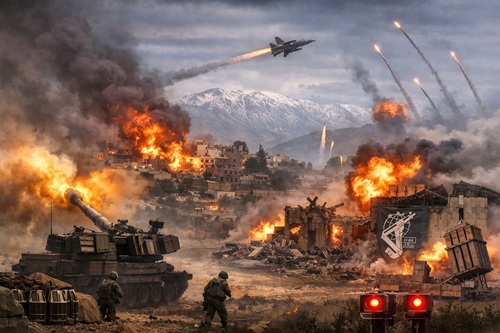
Israel expanded its military campaign by launching strikes not only inside Iran but also against the Iranian-backed Hezbollah militant group in neighboring Lebanon. Lebanese authorities say the fighting has displaced more than half a million people and caused more than 300 deaths.
Israeli Prime Minister Benjamin Netanyahu indicated that further developments could follow in the next phase of the conflict, stating there would be “many surprises.” Israeli officials also reported that their military destroyed the headquarters of the Revolutionary Guard Air Force, which had been responsible for operating the ballistic missile command. Additional strikes reportedly targeted ballistic missile launchers and facilities used for missile production.
Within Israel, eleven people have died since the war began. Air raid alerts have continued to sound multiple times each day across the country as incoming projectiles are detected. Israeli officials say nearly all of those projectiles have been intercepted.
United States
The U.S. military issued warnings advising Iranian civilians to remain indoors, asserting that Iran has been launching attacks from densely populated areas. Evidence also continued to emerge suggesting that the United States may have been responsible for a deadly strike on a girls’ school in Iran during the first day of the conflict. President Trump, however, suggested that Iran itself was responsible for that attack.
Trump also attended the return of the remains of American soldiers who were killed during the war. Seven U.S. service members have died since the fighting began.
Families of American detainees being held in Iran have expressed concern that their relatives could face additional risks as the conflict escalates. At the same time, the U.S. military did not provide an updated figure for the number of missiles and drones Iran has launched in recent days. Earlier assessments had indicated that the pace of those attacks had decreased sharply. Some experts suggested that Iran may be reserving part of its missile arsenal for potential future use.
Middle East
Regional tensions have expanded beyond the primary combatants. The head of the Arab League described Iran’s war strategy as “reckless,” while several Gulf nations reported intercepting Iranian missiles and drones over areas that do not host U.S. military forces.
No country other than the United States and Israel has publicly acknowledged launching attacks on Iran. However, several nations in the region host American military facilities or troops, which has raised concerns about the broader implications of the conflict. Iran has urged countries in the region not to allow the United States to conduct attacks against it from their territories.
The violence has also reached diplomatic compounds and border areas. A missile struck a helicopter landing pad located within the U.S. Embassy complex in Iraq.
Additional deaths have been reported across the region. Saudi Arabia said that a falling military projectile killed two people from Bangladesh. Kuwait reported that two of its border guards had been killed, while the United Arab Emirates said a driver died in a separate incident.
Foreign residents and migrant workers have made up the majority of those reported killed in the Gulf region. In total, more than a dozen deaths have been reported across those countries.
Globally
The consequences of the conflict have spread beyond the Middle East. The U.S. government attempted to reassure Americans that the spike in fuel prices is expected to be temporary, even as the surge in oil prices has provided economic benefits to Russia.
Travel disruptions have also affected thousands of people. Many travelers and religious pilgrims remain stranded throughout the Middle East due to flight disruptions and security concerns. The U.S. State Department said that more than 32,000 Americans have already left the region since the fighting began.
Security concerns have extended to major transportation hubs as well. At Dubai International Airport, passengers waiting for flights were directed into train tunnels after several explosions were heard nearby. Kuwait reported that drones targeted fuel storage tanks at Kuwait International Airport.
The conflict has also begun to draw additional international involvement. Ukrainian President Volodymyr Zelenskyy announced that Ukraine will send experts to assist the United States and its Middle Eastern allies in defending against Iranian drone attacks beginning next week.
The Conflict’s Growing Regional and Global Impact
As the war enters its tenth day, the conflict continues to affect multiple countries across the Middle East while drawing responses from governments around the world. Leadership changes in Iran, expanding military operations by Israel, rising casualty numbers, and growing international involvement illustrate the scale of the crisis. With oil markets reacting, civilian infrastructure affected, and millions of people experiencing displacement or travel disruptions, the war’s consequences are being felt far beyond the immediate battlefield.